Nature Introduction

Would you like to know a bit more?? Check what we have for you in this Post

Hunting

Fun?... Sport?... Killing?. Read more about this practice

Endangered Species

Is time for us to do something about it!!! We can stop this MASSACRE

Animal Abuse

Humanity can be more dangerous than animals, so....We are the Animals!!

Wednesday, May 30, 2012

HISTORY

Homo Sapiens Hunting a big Rhyno with Sticks and Stones
Hunting has a long history and may well pre-date the rise of the species Homo sapiens. While our earliest Hominid ancestors were probably frugivores or omnivores, there is evidence that earlier Homo species, and possibly also Australopithecine species used larger animals for subsistence.

Furthermore there is evidence that hunting may have been one of the multiple environmental factors leading to extinctions of the holocene megafauna, and their replacement by smaller herbivores. It has been found that the North American megafauna extinction was coincidental with the Younger Dryas impact event, possibly making hunting a less critical factor in prehistoric species loss than had been previously thought. However, in other locations such as Australia, humans are thought to have played a very significant role in the extinction of the Australian megafauna that was widespread prior to human occupation.

Of the closest surviving relatives of the human species, Pan, the Common Chimpanzee has an omnivorous diet, which includes troop hunting behaviour based on beta males being led by an alpha male, however the less violent Bonobos, have a mostly frugivorous diet.
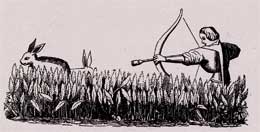
Hunting with a Bow

While it is undisputed that early humans were hunters, the importance of this for in the emergence of the Homo genus from the earlier Australopithecines, including the production of stone tools and eventually the control of fire, are emphasised in the hunting hypothesis, and de-emphasised in scenarios that stress omnivory and social interaction, including mating behaviour, as essential in the emergence of human behavioural modernity. With the establishment of language, culture, and religion, hunting became a theme of stories and myths, as well as rituals such as dance and animal sacrifice.

Use of Guns for Hunting
Hunting was a crucial component of hunter-gatherer societies before the domestication of livestock and the dawn of agriculture, beginning about 11,000 years ago. By the Mesolithic, hunting strategies had diversified with the development of the bow by 18,000 years ago and the domestication of the dog about 15,000 years ago. There is fossil evidence for spear use in Asian hunting dating from approximately 16,200 years ago.


Many species of animals have been hunted throughout history. It has been suggested that in North America and Eurasia Caribou and wild reindeer "may well be the species of single greatest importance in the entire anthropological literature on hunting" although the varying importance of different species would depend on the geographic location.

Hunter-gathering lifestyles remained prevalent in some parts of the New World, Sub-Saharan Africa, and Siberia, as well as all of Australia, until the European Age of Discovery. They still persist in some tribal societies, albeit in rapid decline. Peoples that preserved paleolithic hunting-gathering until the recent past include some indigenous peoples of the Amazonas (Aché), some Central and Southern African Bushmen (Hadza people, Khoisan), some peoples of New Guinea (Fayu), the Mlabri of Thailand and Laos, the Vedda people of Sri Lanka, and a handful of uncontacted peoples.

ANIMAL ABUSE

Advertising Campaing to stop Animal Abuse
Since the dawn of time, man has had various uses for animals. Until the eighteen hundreds, the predominant use was for food and clothing. Today, animals appear to exist for another purpose: providing a form of entertainment for mankind. Using an animal for entertainment is not necessarily a bad thing. A problem arises when training practices and animal stunts cross the line between humane and inhumane treatment. When the line is crossed, the use of animals for man’s entertainment can be classified as inhumane and immoral.

Visibly beaten and abused Dog


Cruelty to animals, also called animal abuse or animal neglect, is the infliction of suffering or harm upon non-human animals, for purposes other than self-defense. More narrowly, it can be harm for specific gain, such as killing animals for food or for their fur, although opinions differ with respect to the method of slaughter. Diverging viewpoints are held by jurisdictions throughout the world.


Broadly speaking, there are two approaches to the issue. The animal welfare position holds that there is nothing inherently wrong with using animals for human purposes, such as food, clothing, entertainment, and research, but that it should be done in a humane way that minimizes unnecessary pain and suffering. Animal rights theorists criticize this position, arguing that the words "unnecessary" and "humane" are subject to widely differing interpretations, and that the only way to ensure protection for animals is to end their status as property, and to ensure that they are never used as commodities.

Laws concerning animal cruelty are designed to prevent needless cruelty to animals, rather than killing for other aims such as food, or they concern species not eaten as food in the country involved, such as those regarded as pets.


ENDANGERED SPECIES


An endangered species is a population of organisms which is facing a high risk of becoming extinct because it is either few in numbers, or threatened by changing environmental or predation parameters. 

Their reproductive rates are lower than their mortality rates over long periods of time, so their numbers are diminishing. The reasons for this are varied, but lately, very often involves a loss of habitat as people encroach on their living areas.

The International Union for Conservation of Nature (IUCN) has always calculated the percentage of endangered species.

When a species is listed as endangered or threatened, it is not a death sentence. Many animals, like the bald eagle and the American alligator, were on the brink of extinction and are now recovering. Many species, however, will not recover, and could be lost forever.


Many nations have laws offering protection to conservation reliant species: for example, forbidding hunting, restricting land development or creating preserves.

Only a few of the many species at risk of extinction actually make it to the lists and obtain legal protection like Pandas. Many more species become extinct, or potentially will become extinct, without gaining public notice.

Please go and learn more about this topic on the tabs below link ENDANGERED SPECIES


HUNTING


Hunting is the practice of pursuing any living thing, usually wildlife or feral animals, for food, recreation, or trade. In present-day use, the term refers to lawful hunting, as distinguished from poaching, which is the killing, trapping or capture of the hunted species contrary to applicable law. The species which are hunted are referred to as game, and are usually mammals and migratory or non-migratory gamebirds.


Men Hunting with their dog

Hunting can also involve the elimination of vermin, as a means of pest control to prevent diseases caused by overpopulation. Hunting advocates state that hunting can be a necessary component of modern wildlife management, for example to help maintain a population of healthy animals within an environment's ecological carrying capacity when natural checks such as predators are absent. In the United States, wildlife managers are frequently part of hunting regulatory and licensing bodies, where they help to set rules on the number, manner and conditions in which game may be hunted.

The pursuit, capture and release, or capture for food of fish is called fishing, which is not commonly categorised as a form of hunting. Trapping is also usually considered a separate activity. It is also not considered hunting to pursue animals without intent to kill them, as in wildlife photography or birdwatching. The practice of hunting for plants or mushrooms is a colloquial term for foraging or gathering.

Skilful tracking and acquisition of an elusive target has caused the word hunting to be used in the vernacular as a metaphor, as in treasure hunting, "bargain hunting", and even "hunting down corruption and waste".

Also exist the most common way of hunting: The animal hunting, either individually or in packs, is developed for a life instinct, they just do this because is a way to survive, they feel the need to feed themselves using any possible way. 

A Female Lion Hunting a deer

We invite you to learn about this topic on the tabs below link HUNTING


NATURE


Nature, in the broadest sense, is equivalent to the natural world, physical world, or material world. "Nature" refers to the phenomena of the physical world, and also to life in general. It ranges in scale from the subatomic to the cosmic.

The word nature is derived from the Latin word natura, or "essential qualities, innate disposition", and in ancient times, literally meant "birth". Natura was a Latin translation of the Greek word physis (φύσις), which originally related to the intrinsic characteristics that plants, animals, and other features of the world develop of their own accord. The concept of nature as a whole, the physical universe, is one of several expansions of the original notion; it began with certain core applications of the word φύσις by pre-Socratic philosophers, and has steadily gained currency ever since. This usage was confirmed during the advent of modern scientific method in the last several centuries.

Within the various uses of the word today, "nature" often refers to geology and wildlife. Nature may refer to the general realm of various types of living plants and animals, and in some cases to the processes associated with inanimate objects – the way that particular types of things exist and change of their own accord, such as the weather and geology of the Earth, and the matter and energy of which all these things are composed. It is often taken to mean the "natural environment" or wilderness–wild animals, rocks, forest, beaches, and in general those things that have not been substantially altered by human intervention, or which persist despite human intervention. For example, manufactured objects and human interaction generally are not considered part of nature, unless qualified as, for example, "human nature" or "the whole of nature". This more traditional concept of natural things which can still be found today implies a distinction between the natural and the artificial, with the artificial being understood as that which has been brought into being by a human consciousness or a human mind. Depending on the particular context, the term "natural" might also be distinguished from the unnatural, the supernatural, or synthetic.


A BEAUTIFUL LANDSCAPE


Share

Twitter Delicious Facebook Digg Stumbleupon Favorites